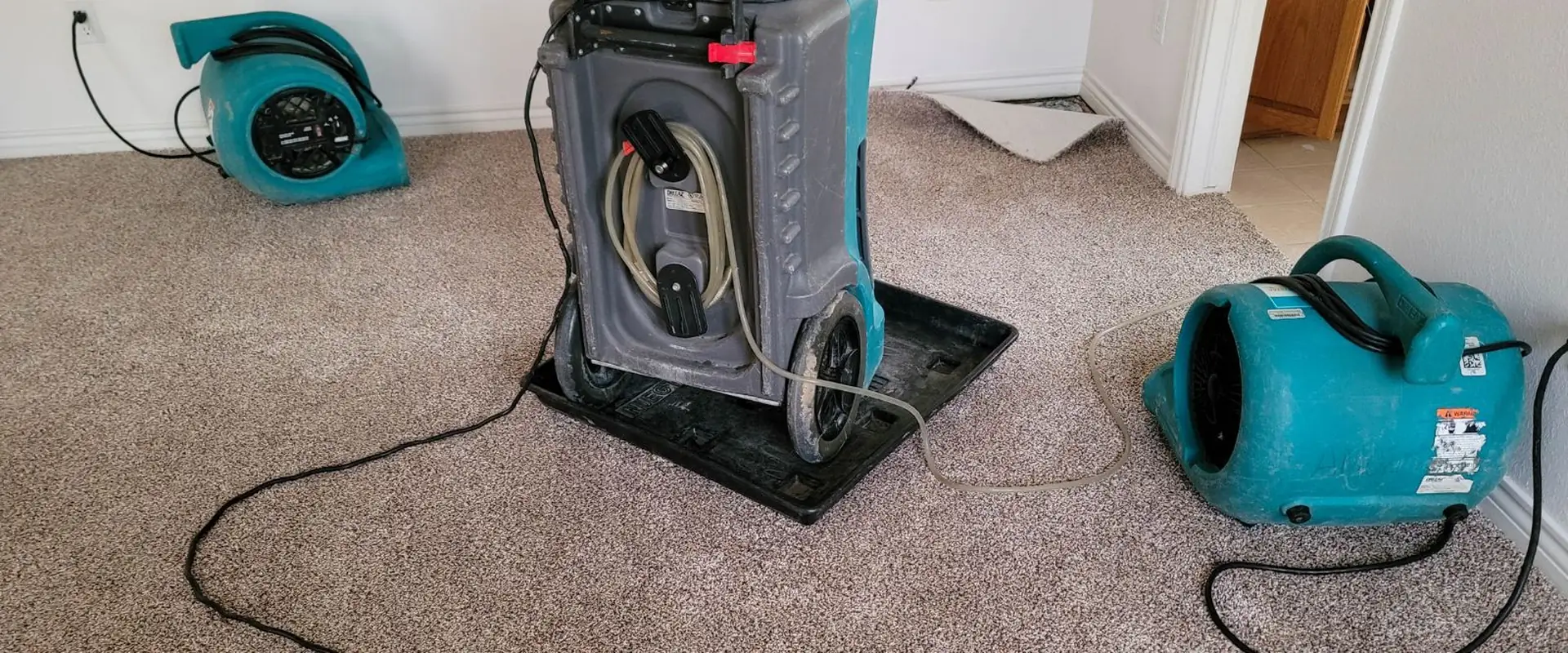
What structural drying is and why it takes days
.Structural drying is the phase after standing water is gone. Water has soaked into drywall, framing, subfloor, insulation and concrete, and it has to leave as vapor. Drying equipment creates conditions that move it out of materials and into the air, and then out of the air.
This page covers the drying phase and how it is checked. The first-day emergency work of stopping the source is on water mitigation. Pumping standing water is on emergency water removal. Rebuilding afterward is on water damage repair.
How we map where the water went
.Surface wetness is not the problem, since a floor can feel dry while the joists below read wet. A moisture meter pressed to drywall, wood and concrete gives numbers. A thermal camera shows cooler zones where evaporation or damp insulation sits, which guides where the meter goes.
We record readings in a log, by room and by material, and compare them with a dry reference in an unaffected area of the same house. That reference becomes the drying goal for each material.
| Equipment | What it does | Where it is used |
|---|---|---|
| Air mover. | Moves air across a wet surface so water evaporates faster. | Floors, lower walls, carpet and ceilings. |
| LGR dehumidifier. | Cools air to condense water out of it. | Heated rooms, basements and finished spaces. |
| Desiccant dehumidifier. | Uses a drying wheel and works in cold air. | Cold crawl spaces, garages and unheated rooms. |
| Wall cavity drying. | Moves dry air through small openings in the wall. | Cavities behind baseboards and cabinets. |
| Moisture meter and thermal camera. | Find wet zones and confirm dry ones. | Every visit. |
Cool winter air changes the equipment, not the principle. A refrigerant dehumidifier gives up efficiency as the room cools, so an unheated crawl space or garage often calls for a desiccant unit, and a heated living room works well with an LGR unit. Outdoor air in a wet Puget Sound winter carries moisture too, which is why opening windows rarely dries a house.
Drying safety: what not to do
.- Leave the equipment running. Turning it off to sleep lets materials reabsorb moisture.
- Do not move air movers or unplug dehumidifiers without calling the crew.
- Keep power cords out of standing water and off wet floors. Report any tripped breaker.
- Keep exterior doors closed. Open doors let humid outdoor air in.
- Do not turn on the HVAC system after a sewage or mold loss until a pro checks the ducts.
- Call 911 if you smell gas or see sparks.
Wet walls, floors or a flood-dried house?
Call the 24/7 line. We map the moisture and set up drying equipment.
The daily drying routine
.Set the equipment
Air movers and dehumidifiers are placed to match the moisture map and the room volume.
Read the meters
A technician returns each day, records readings and compares them to the dry reference.
Adjust
Equipment is moved, added or removed as readings fall. Wet cavities that are not drying are opened.
Pull the equipment
Equipment leaves only when each material has reached its goal.
How we know drying is done
.Drying is judged by measurement, not by feel. The goal for each material is its normal dry reading in that building, and the published reference for judging restoration drying is ANSI/IICRC S500, which we cite as a reference and not as a certification. Drywall, framing, subfloor and concrete each have their own dry reading.
The finish line is documented. You can ask for the logs. Rebuilding on wood that still reads wet traps moisture, so a final set of readings comes before any wall is closed. Washington's health department notes that there are no state certification requirements for water damage restoration, so asking what standard and records a company uses is reasonable.
What affects the cost of structural drying
We explain scope and price before work starts. These factors move the drying bill.
Affected area
Cubic feet of wet space set the number of machines.
Materials
Concrete, hardwood and plaster dry slowly.
Days of drying
Equipment days add up, so a slow-drying material costs more.
Access
Cabinets, tight crawl spaces and finished walls add labor.
Drying time varies by building, so ask for the readings that show progress.
Insurance and the drying scope
.The Washington insurance commissioner says that when a policy requires mitigation, insurers have five business days to approve a mitigation scope, and that you may choose your own contractor. Ask your insurer which records it wants, and keep the drying logs. Coverage is decided by your policy, not by us.
Mistakes that slow drying
.- Running fans without dehumidifiers. That moves wet air around and can spread moisture.
- Stopping early because the surface feels dry.
- Closing wall cavities before a reading proves them dry.
- Leaving wet carpet pad or insulation in place.
Whether it is a creek-side house in Woodinville or a townhome in Kirkland, the sequence is the same. After drying, a leak that has fed mold goes to mold remediation.
Common questions about structural drying and dehumidification
Yes. The dispatch line is answered 24/7, including nights and weekends. We offer same-day response when available and do not promise an arrival time.
It depends on the materials and the water. Many losses take several days, and concrete or hardwood can take longer. The daily readings tell us.
Air movers and dehumidifiers work around the clock. Turning them off lets materials reabsorb water and extends the drying time.
Rarely in a Bothell winter, because the outdoor air is humid. Dehumidifiers do most of the work, and the CDC suggests fans placed in a window or door that blow outward.